The Art of Installation

In exploring the Grandstands endless possibilities you stumble across that one idea that sets a chain reaction in your head leading you to concepts you would never have originally thought about. In the event of my chain reaction I stumbled across installments and their importance in contemporary performance as an art form in their own right “INSTALLATION ART is a broad term applied to a range of arts practice which involves the installation or configuration of objects in a space, where the totality of objects and space comprise the artwork.” (Irish Museum of Modern Art, 2012) Through this research you understand that you have to define the space used for the configuration, through looking at maps of the grandstand and using my own experiences of drifting I decided upon what looked to be a decaying set of toilet cubicles.

Located Through the Kitchen

The space appeared to still be used but simply as a convenient storage closet. The paint was coming off of the walls, the toilets would not flush and the was a wild variety of wildlife growing within the space. Yet, all of these flaws I simply took on as quirks, qualities that made the space what it is because after all this process is not about finding the negatives but twisting them and transforming them into positives. Already through my own judgements it could be seen that this acted as a piece of installation art, it showed years of decay “These values concern a desire to activate the viewer – as opposed to the passivity of mass-media consumption – and to induce a critical vigilance towards the environments in which we find ourselves.” (Bishop, 2005) I wanted to take this idea of ‘crucial vigilance’ one step further by presenting all of the decaying environments I saw into this once space.

Therefore, I looked through my own documentation of the grandstand I had created on my first visit and what I saw was consistent decay and objects relevant to the site with items such as the windows being painted on the back rather than being actual windows. With abandoned stables and litter everywhere. I wanted to present this documentation and so created something to show the modern age against the past, through the use of a video.

What use to be

I entitled the video ‘What use to be’ and presented it in the space on the cubicle seat using only the dim natural light of the blocked out skyline windows. I then thought to myself how could I continue this concept of documentation and decay and did this through taken pictures of people as they walked into the space. I wanted to capture the look of shock as they saw the decay that had occurred. Through adding the audio of the start of the Grand national Race I believe it explored the further history of the site and how it use to be used as a race course.

Decay on the Walls

This proved to me to be a huge leap in the understanding of Site Specific performance and that it is not about acting it is about representing the site in a way that is not usually perceived “Site-specific performance… reveals the complex two-way relationship between the person and the physical environment.” (Harrison, 2010) This is the main creation I have made, fusing people with the physical environment with the atmosphere of the space and the documentation showing what may have been missed.

References:

Irish Museum of Modern Art (2012) What Is – Installation Art, Dublin: Irish Museum of Modern Art.

Bishop, C. (2005) But is it Installation Art? Tate Etc, 3 (Spring). [online] London: Tate. Available from http://www.tate.org.uk/context-comment/articles/it-installation-art [Accessed 5 March 2014].

Harrison, B. (2010) Theatre Style: Site Specific Performance. [online] Scotland: Scottish Arts Council. Available from http://www.scottisharts.org.uk/1/artsinscotland/drama/features/archive/themesitespecifictheatre.aspx [Accessed 5 March 2014].

Talking SENSE

‘Offers them opportunity to open their senses to the land they are living in/on, and participate, physically immerse in it. It invites them to pay attention to what they pay attention to.’ (Taylor, 2008, p. 140)

In everyday life, we naturally use our senses to get by. We use them to see, hear, taste, smell and feel the world around us. It’s instinctive. However, in relation to theatre, the exploration and experimentation of these senses is quite intriguing as well as extremely challenging for a performer, director and audience member. Theatre is normally regarded as a visual and auditory art, whether that’s concentrated on performers in a physical dance piece or the elaborate set design of an award-winning production, intertwined with pieces of music and the spoken voice. During last week and into this week, we have all been learning how all five senses can be explored in relation to theatre and in particular, how we would incorporate this concept to our developing performances within this site.

After discussing the possibilities of fusing experimentation of the senses into our growing drama piece, the whole group were given the task to present a 5-10 minute piece in our next site visit which integrated our thoughts and ideas. We felt inspired by what we had learnt in lesson from various practitioners and companies performances so looked forward to adding this to our performance idea of ‘Waiting Room’ (More details about specific performances ideas to follow).

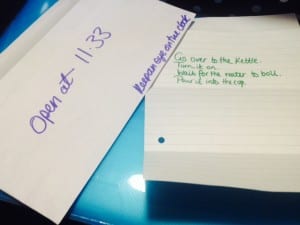
On site, we set out chairs as in the shape of a general waiting room, placing an envelope on the majority of chairs. These envelopes held instructions to the individual who chose to sit there, for example  ‘Open at 11.34am’ or ‘Open when you hear crying’ were written on the front of the envelope and inside another instruction would be given such as ‘Put the kettle on, pour water into mug and give to another audience member’.

imageimage (1)

The use of these envelopes allowed us to be in control of the piece and directly see how the notion of ‘senses’ could be an interesting part of the ‘Waiting Room’. Just from these 2 example instructions, the use of smell, touch, sight, audio and perhaps taste (depending if the audience member drank the coffee) are evident:

SIGHT: The dependence on keeping an eye on the clock to know when to open certain envelopes, to read the instructions given, to see the other audience members partaking in their tasks.

SMELL: The smell of coffee that was being made by an individual participant, the perfume we sprayed on the seats and envelopes before the audience members came in.

SOUND: Sound of kettle boiling, sound of crying, sound of scratching pens on a writing pad.

TOUCH: More to do with ‘feeling’- turning all the heaters off so that the room was uncomfortably cold. The contrast between the cold room and the hot coffee mug and individual was given.

TASTE: Again perhaps for an audience member who may drink the coffee.

After presenting to the class and receiving feedback, we felt that this concept is something that we would like to build upon because of how much it contributed to the atmosphere, creating an interesting dimension to the piece. Participants agreed with this and said that it gave a heightened atmosphere from the start due to the temperature of the room and pressure of fulfilling a given task. We could see for ourselves how this made audience members feel different (uncomfortable, unsafe, unsure) in comparison to viewing other performances, both individually and as a whole group of people.

Our main inspiration was Rotozaza’s ‘Etiquette’ due to the focus on an individual/pair’s reaction to the experimentation of their senses. This 30 minute ‘experience’ is an example of how auditory given tasks challenge the audience members by exposing ‘human communication at both it’s rawest and most delicate’ (Rotozaza, 2007) through the use of headphones.

shapeimage_2

Captured in Buenos Aires by Nicholas Goldberg.
Etiquette. Online: http://www.rotozaza.co.uk/etiquette2.html [Accessed on 10 March 2014]

‘If the line between audience and performer seems blurred, Rotozaza’s ‘Etiquette’ erases it entirely’ (ibid). Etiquette uses the participants as the entire basis for the performance and this is something that we wanted to make evident in our presentation. The whole 10 minute piece relied on our participants to open and fulfill their tasks which led to others opening their envelopes and so on. This brought quite a fresh atmosphere to the piece as a whole as nothing was completely definite, perhaps allowing for many exciting undefined circumstances.

To develop this concept in our idea of the ‘Waiting Room’, we will need to focus on more means of reacting with participant’s senses whilst considering about how this can relate to the context and content of our ideas and what we want to perform.

References:

Rotozaza (2007) Etiquette- Rotozaza’s Micro/Autoteatro Work, Online: http://www.rotozaza.co.uk/etiquette2.html [Accessed 10 March 2014]

Taylor, G (2008) Locating: Place and the Moving Body. PhD. Victoria University, AUS. Online: http://mams.rmit.edu.au/q6n0m9ah9rvcz.pdf [Accessed 10 March 2014]

What Could Have Been…

Sometimes creating a performance within a space can alter the image the audience had of it, “…people had a real familiarity with the space that was being worked with yet they were invited to experience the environment from a new perspective due to the performance that was enacted within it” (Govan, Nicholson and Normington, 2007, p.120). This can be for the better or for the worse or even just to make an audience aware of the potential the space had or has.

That same quote could be used to reflect on how a performance we did at the Grandstand caused the audience to feel different about the site space. Before I talk about the performance I must first explain how we found the inspiration for it…

Having learnt the grandstand could (or might) have been a mortuary, we ventured to the archives to delve further into the history of this somewhat mysterious building. Whilst at the archives we discovered a detailed plan showing the layout for the mortuary within the grandstand, as shown below.

2014-03-06_00.53.22[1]                                                                    Mortuary plan, courtesy of the Archives (Lincoln)

Although we knew that a mortuary is what the building could have been used for, seeing the plan really made me think about the space and the layout of the grandstand. For example, they had planned to place the mortuary in a room where children now run around and play with toys. Witnessing the plan created more awareness of how close the grandstand was to becoming a mortuary, but there is no evidence either way to suggest it was or wasn’t a reality.

So for our performance we expanded on the chair performance which we did a couple of weeks ago. However this time we incorporated text. On post-it notes we wrote down sayings to do with death, sadness and the war. This allowed us to focus on the destruction the soldiers and families went through during World War II. The destruction could also be a metaphor for how, if the grandstand was used as a mortuary, the family friendly place it once was would no longer exist, destroying the grandstand’s family friendly image.

Our performance involved the performers walking through chairs that are knocked over as if something has ruined the site. The performers then slowly, and when they feel like doing so, lie down on the floor. This represents the victims of the war and highlights the area as a place where bodies could have lay. Then one-by-one the performers rise up and collects their shoes and find a post-it note which they then read out. Once they have done this, the performer proceeds to stand in front of the audience just staring emotionless. Once all performers are lined up they read out their post-it note again and put it on the post. They then walk into the kitchen and lie down on the floor (one-by-one) where I covered them, from the waist up, with their coats. Then another performer brought the audience into the kitchen and in this tiny cramped room the faces of the ‘bodies’ (the performers on the floor) where revealed whilst the audience were being asked if they recognised anyone.We chose to use the kitchen in our piece because we discovered it would have been the viewing room, according to the mortuary plans.

We wanted the audience to feel a part of the piece, that is why we made them feel like they were involuntarily in a room identifying bodies, similar to how the families of the World War II victim’s would have felt, “…the work is constructed so that the performers interact with the people who inhabit a particular place” (Govan, Nicholson and Normington, 2007, p.122). By having the audience crammed into a small room and showing them faces of people, as if they were dead, caused the grandstand to be seen as a dark place rather than the happy one it is depicted, through the brightly painted walls.

Through our research and performance we managed to give the audience a different view of the grandstand and one which will, hopefully, open their eyes to what could have been!

Work Cited:

Govan E., Nicholson H. and Normington K., ‘The Place of the Artist’ Making a Performance, Oxon: Routledge, 2007, p.120-135

The Mortuary Plan courtesy of the Archives in Lincoln.


Dear Grandstand

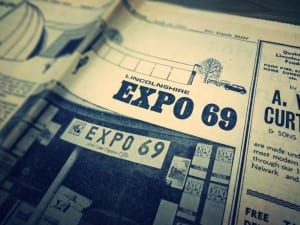
So it turns out you held an expo in 1969. Well it wasn’t technically within your walls but i bet you had a great view. I read a lot of interesting stuff about a fashion show with a stainless steel dress and a parade through the city that was disrupted by the always reliable train crossings.

a75f1a3a-6fad-4a2d-bc0a-ccc253c267ed

It’s interesting thinking about you during this time. I bet you looked a lot different, not so out of place. The memory of the horse racing and the big events that took place had probably not faded in the five years you’d closed your doors. I bet inside you were more authentic, more like you were intended to look.9ef91673-cab5-46a4-ae0d-f834496b8c95

Nonetheless, back to Expo 69. A lot of companies seemed to have walked out of the expo with success. Curtis’ for example is now a big Lincolnshire company and they were selling pork pies at the expo 45 years ago. It unbelievable that one event could kick start a company like that. I’m sure there was a lot of work else where also but it’s nice to think that the expo really befitted companies that are still around today.

fa01d7e4-3108-418b-b632-9b7c050cbacb

See you soon.                                                                                                             Best Wishes,                                                                                                              Alice Dale.


A-V-L-A-V-L-A-L-A-V-A-L-V-A-L-L-A-V-A-L

Dear Grandstand,

Yesterday I learnt that you, although small, seem to appear on every map. That you’re aged and are still there even in the maps dating back to 1845. You are not big and overwhelming but rather sitting there on the edge of each map waiting to be rediscovered.

I discovered that you use to have siblings, that you were not the only one and now you are. I’m finding it difficult to talk about it without Romanticising you. Judging by the maps you don’t want to be Romanticised, you just want to exist. Subtly and quietly on the map, a tiny little building compared to the city of Lincoln with a tiny name tag.

Throughout the years you’ve barely even changed compared to the West End of Lincoln and the commons surrounding you. Perhaps it’s time you changed, what do you think?

Perhaps it’s time you changed, what do you think?

Yours Sincerely

Adam Robinson

What can you see?

What can you see?